Time you can trust
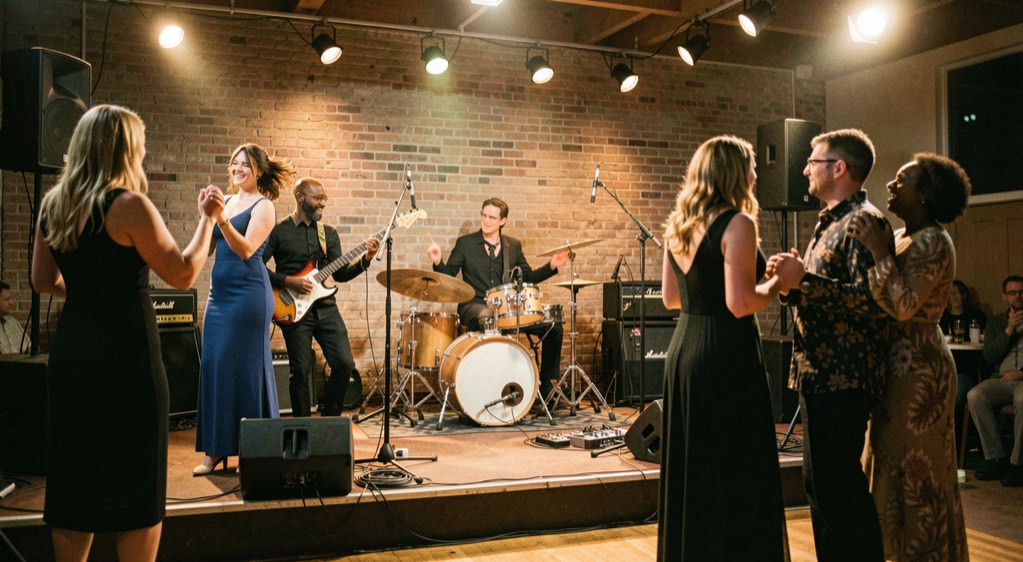
A dance-friendly band gives the room a pulse that can be found quickly. Tempo changes can be wonderful when the transition is legible and dancers have enough time to settle. A band does not need to play a simple arrangement to serve a social floor. It needs to understand that people are translating sound into weight, travel, connection and recovery in real time.
Play to the floor without flattening the music
Good social-dance bands keep their character while respecting the room’s physical needs. A strong backbeat, clear endings and a sense of phrase help dancers make choices without turning the set into a metronome. The band can stretch, stop and surprise, but it should offer enough information for a partner to hear the next idea rather than guessing through every bar.
A pre-show protocol
Before the event, the band and organizer should agree on stage position, sound check, set length, breaks, floor access and who communicates a change. A DJ or teacher can explain the room’s level. A venue can identify the safe cable path. These are ordinary logistics, but they protect the dance from a last-minute scramble that nobody on the floor can solve.
Common errors
A set can become difficult when the monitor mix hides the pulse, the volume makes conversation impossible or the band changes tempo without a usable transition. Another error is treating dancers as a passive audience. They are giving immediate feedback through spacing and energy. A band does not have to obey every reaction, but it should be able to see and interpret the room.
Venue history is context, not proof of a booking
Cincinnati’s Music Hall histories document big-band dance events and the ballroom’s physical role. That tells us why rooms matter. It does not prove that a particular band, date or style is scheduled there now. Historic architecture can frame an article, while the current event page remains the authority for the present.
A useful example
In a 45-minute set, a band opens with a clear medium groove, moves to a brighter number after the floor has settled, speaks before a deliberate tempo change and closes with a record-like phrase that lets couples finish. The dancers feel the shape of the set because the band has made the transitions legible without removing its own voice.
Source trail
Cincinnati Arts and Friends of Music Hall provide the venue history used here. Current bands, venues and organizers should be credited through their own pages. Cincy Bop Bulletin can report how a room functions, but it does not review a performance it has not attended or invent a present lineup.
Read the room, name the source and leave space for the next dancer. That is a useful rule whether the page is an archive record or a current lead.